
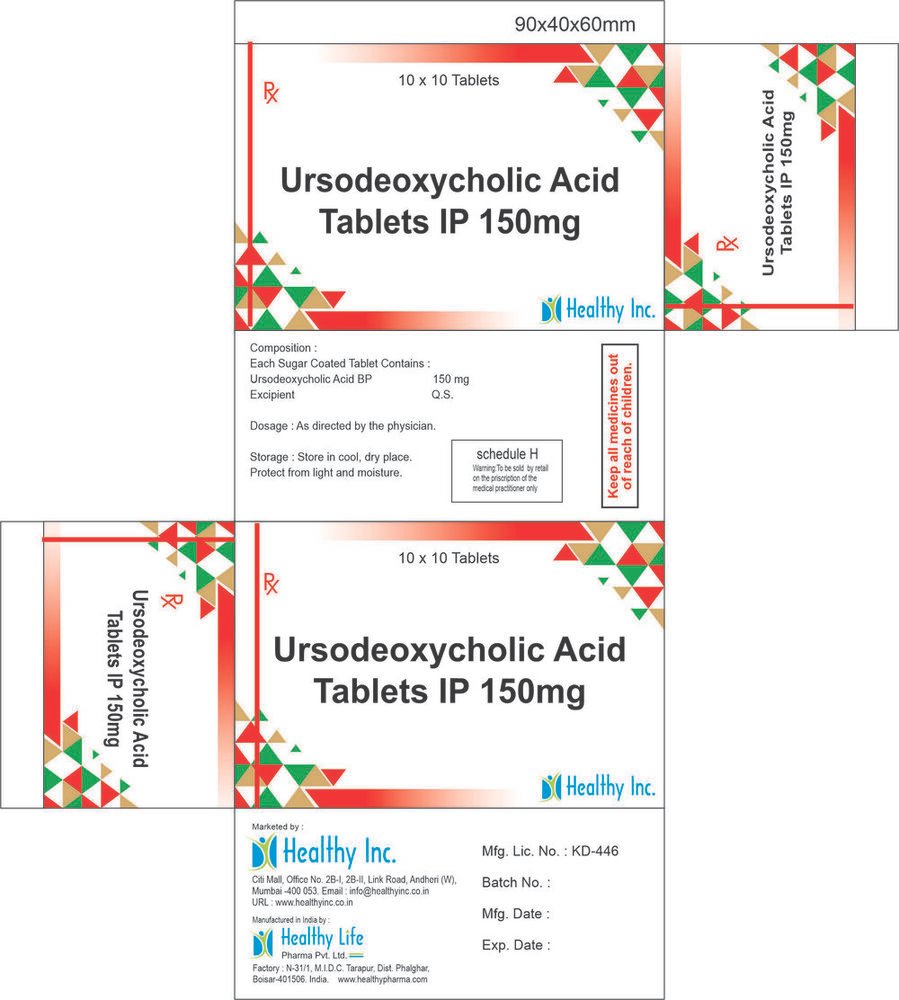
Ursodeoxycholic acid (ursodiol/UDCA) oral tablets for approved hepatobiliary indications, including primary biliary cholangitis and selected cholesterol gallstones.
Active ingredient: Ursodeoxycholic Acid (UDCA / Ursodiol).
Strengths described in the product brief: 150 mg, 300 mg and 600 mg. Each strength, dosage form and local approval should be confirmed against its final registered label.
Therapeutic category: Bile acid / Hepatobiliary agent.
Manufacturer named in supplied brief: Healthy Life Pharma Pvt. Ltd. Exporter named: Healthy Inc. Certifications and export-house status require current documentary verification.
B2B enquiries: +91 7710003340
Ursodeoxycholic Acid Tablets is listed for pharmaceutical business-to-business enquiries. Exact active ingredients, formulation, strength, pack configuration and manufacturer details should be confirmed against the product label and approved technical documentation before ordering.
Ursodeoxycholic acid (UDCA), also known as ursodiol, is a hydrophilic bile acid used for selected hepatobiliary disorders. It is an established first-line pharmacological treatment for primary biliary cholangitis (PBC), and may dissolve selected non-calcified cholesterol gallstones in patients meeting appropriate criteria.
Healthy Life Pharma Pvt. Ltd. is identified as manufacturer and Healthy Inc as exporter in the supplied commercial brief. Facility certifications, actual product registrations and manufacturing capability must be confirmed with current records.
| Product | Ursodeoxycholic Acid Tablets (Ursodiol / UDCA) |
|---|---|
| Strengths described | 150 mg / 300 mg / 600 mg (separate presentations, subject to registration) |
| CAS number | 128-13-2 |
| Dosage form | Oral tablets; film coating/scoring subject to approved product specification |
| Therapeutic class | Bile acid / Hepatobiliary agent |
| Pharmacopoeial standard | Applicable USP, BP, IP or registered specification, depending on product and market |
| Packaging | To be confirmed against approved pack and stability data |
| Shelf life | To be confirmed from approved stability data |
UDCA has limited aqueous solubility. Formulation development may assess API particle-size distribution, excipient compatibility, blend uniformity, compression properties and dissolution performance. Micronization, granulation, film coating and other technologies are potential approaches, but should not be represented as the actual manufacturing process without batch and validation evidence.
Any claimed high-dose 600 mg presentation requires separate development, approved specifications and stability assessment.
Fixed numerical assay or dissolution limits should not be published unless they match the specific applicable monograph and product registration.
UDCA alters the composition of the bile acid pool and reduces the cholesterol saturation of bile. In PBC it can improve biochemical markers and clinical outcomes. For selected cholesterol gallstones, it may gradually promote dissolution, although response is variable and recurrence can occur.
Not a standard treatment for fatty liver disease (MASLD/NAFLD) solely to improve liver outcomes. It does not dissolve all types of gallstones and is not a substitute for urgent management of biliary obstruction or infection.
Potential B2B registration support may include country-specific technical dossiers, certificates of analysis, product specifications and approved packaging details, subject to availability.
Claims concerning WHO-GMP, COPP, FSC, Star Export House status, shipping terms and approved markets should be checked against valid current documents. Product supply remains subject to destination-country registration and import requirements.
Q: Is UDCA the same as ursodiol?
A: Yes, ursodiol is another name for ursodeoxycholic acid.
Q: Does UDCA dissolve every gallstone?
A: No. It may work for selected cholesterol stones; calcified or pigment stones generally do not respond.
Q: How long can gallstone treatment take?
A: Months of treatment may be needed, and success is not guaranteed. Imaging and clinical monitoring guide continuation.
Q: Are 150 mg, 300 mg and 600 mg approved in every market?
A: Not necessarily. Availability depends on the specific registered product and market.
Dosage is individualized by indication, body weight, formulation and local approved label. Common specialist-guided regimens for PBC are approximately 13–15 mg/kg/day; gallstone regimens vary by jurisdiction and product. These figures are informational, not patient-specific prescriptions.
Take tablets as directed on the approved label; food instructions may vary by product. Do not alter dose, split tablets or stop long-term treatment without clinician advice.
Seek urgent care for severe abdominal pain, fever, jaundice or symptoms suggesting biliary infection/obstruction.
Store according to the approved market-specific label, in the original protective packaging and away from excessive heat and moisture. Do not assume a universal below-25°C condition or 36-month shelf life without approved stability data. Keep out of reach of children.
For healthcare professional and B2B reference. Product availability, approvals, certifications, manufacturing processes, packaging and prescribing details must be verified for the relevant market.