
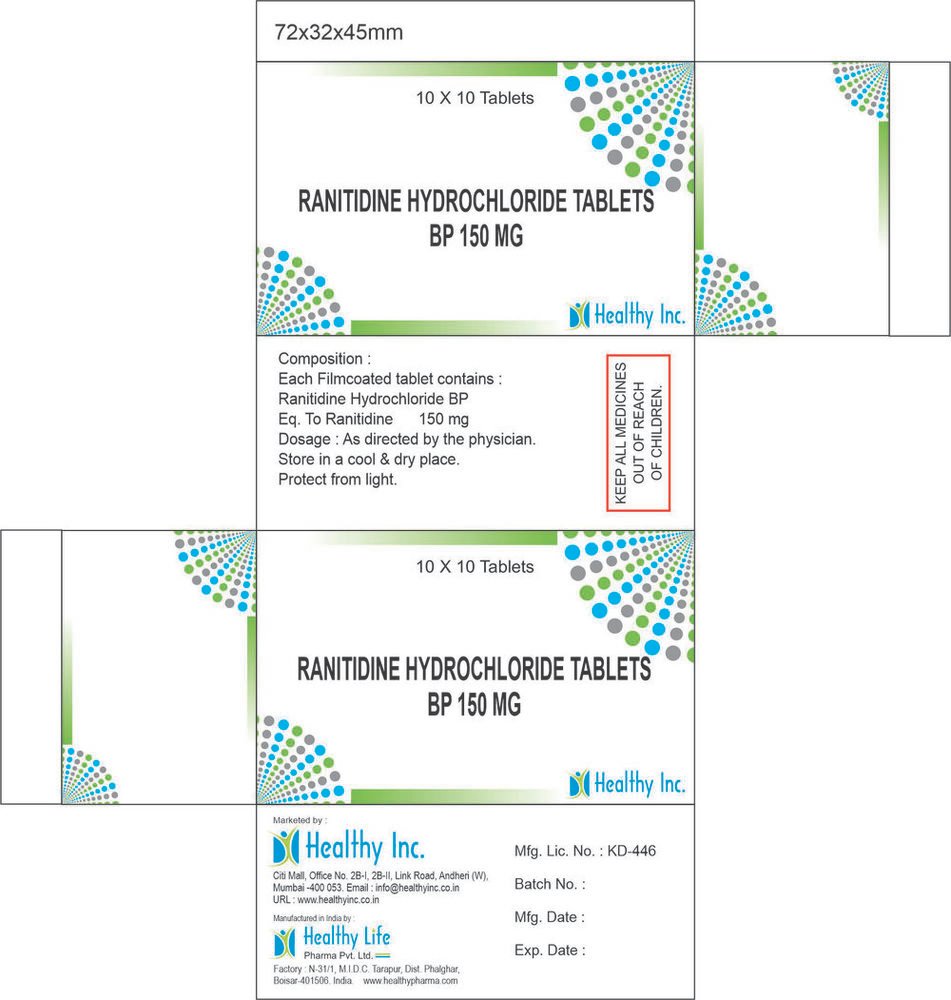
Composition: Ranitidine Hydrochloride IP equivalent to Ranitidine 150 mg or 300 mg; USP 300 mg, as labeled.
Dosage form: Film-coated oral tablets.
Therapeutic category: Histamine H2-receptor antagonist / acid-suppressing agent.
Historical uses: Peptic ulcer disease and GERD, subject to current local authorization.
Regulatory status: Ranitidine has been withdrawn or suspended in multiple markets due to NDMA concerns. Approval and availability must be verified.
Ranitidine HCL Tablet Trader is listed for pharmaceutical business-to-business enquiries. Exact active ingredients, formulation, strength, pack configuration and manufacturer details should be confirmed against the product label and approved technical documentation before ordering.
Healthy Life Pharma Pvt. Ltd. is identified as manufacturer and Healthy Inc as exporter of Ranitidine Hydrochloride Tablets. Ranitidine is a histamine H2-receptor antagonist historically used to reduce stomach acid secretion in peptic ulcer disease and gastroesophageal reflux disease.
Important: Regulatory actions related to NDMA have restricted ranitidine in numerous markets. Any manufacturing, commercial supply or clinical-use claim must be supported by current authorization and product-specific safety evidence. Contract manufacturing and export arrangements require confirmation.
| Product name | Ranitidine Hydrochloride Tablets |
|---|---|
| IP 150 mg | Each film-coated tablet contains Ranitidine Hydrochloride IP equivalent to Ranitidine 150 mg |
| IP 300 mg | Each film-coated tablet contains Ranitidine Hydrochloride IP equivalent to Ranitidine 300 mg |
| USP 300 mg | Each film-coated tablet contains Ranitidine Hydrochloride USP equivalent to Ranitidine 300 mg |
| Dosage form | Film-coated oral tablet |
| Therapeutic class | H2-receptor antagonist (acid suppressant, not a direct neutralizing antacid) |
| Standard | IP / USP, according to specified formulation |
| CAS number | Ranitidine hydrochloride: 66357-35-5 |
| Regulatory status | Country- and product-specific; approval and commercial availability not independently confirmed |
| Shelf life / packaging | Must be established from approved labeling, stability data and current NDMA risk evaluation; proposed 24–36 months not verified |
Ranitidine formulations require a validated control strategy for chemical stability and nitrosamine risk. A manufacturer should evaluate API and excipient nitrite sources, processing conditions, packaging, storage temperature and potential NDMA formation over shelf life.
Specific claims about low-nitrite sourcing, processing equipment, proprietary coating systems and Alu-Alu packaging require manufacturer documentation before publication.
Universal assay or dissolution percentages are not asserted because limits depend on the applicable monograph and approved specification.
Ranitidine inhibits histamine H2 receptors on gastric parietal cells, decreasing gastric acid secretion. It does not neutralize existing acid like a conventional antacid.
These historical indications should not be interpreted as a recommendation to prescribe or use ranitidine where it is withdrawn or unauthorized. Clinicians should consult current local guidance for available alternatives.
For a B2B enquiry, request evidence of current manufacturing and marketing authorization in both origin and destination jurisdictions, plus product-specific nitrosamine risk assessment and any required stability data. CTD/ACTD dossiers, COA, FSC, COPP, GMP documentation, export routes and commercial terms are subject to verification and availability.
No export market, registration approval, NDMA result or certification is represented as independently confirmed on this page.
Q: Which ranitidine formulations are listed?
A: Film-coated IP 150 mg, IP 300 mg and USP 300 mg tablets, expressed as ranitidine base equivalents.
Q: Is ranitidine currently approved everywhere?
A: No. Ranitidine has faced NDMA-related withdrawals or suspensions in multiple countries. Current status must be checked with the relevant regulator.
Q: Does low-nitrite manufacturing guarantee safety?
A: No. Risk controls and appropriate testing are important, but safety and regulatory compliance must be demonstrated with product-specific evidence.
Q: Can buyers request documentation?
A: Contact the supplier to verify product availability, authorization, GMP documents and analytical data.
Historical dosing varied by indication, kidney function and local product labeling. Because of NDMA-related regulatory restrictions, this page does not recommend a ranitidine dose or treatment regimen. Clinicians should first verify that a particular product is legally authorized and clinically appropriate in their jurisdiction, and consult current approved prescribing information.
Patients currently using ranitidine should consult a healthcare professional or pharmacist about current local guidance and alternatives; urgent symptoms require medical evaluation.
Follow the approved market-specific product label. Protect from excessive heat, light and moisture as directed. NDMA concerns cannot be resolved simply by following general storage precautions; product-specific stability and regulatory authorization remain essential. Keep medicines out of reach of children.